Search This Blog

Showing posts with label Pac-12. Show all posts

Tuesday, September 20, 2011

Death of the NCAA

Who among us likes to hear someone, correctly, tell us, “I told you so,”? None of us, I would presume. Even when the person reminding us of how wrong we were all along is a trusted friend or a family member, at best, the statement does little more than beg to original question. Often, that expression serves of a source of annoyance and a reminder of the downside of our stubbornness.

The NCAA appears to be very close to a point which its members, fans, and business partners can tell it that. For years, fans, journalists, and countless other people have called for a playoff system in college football. The NCAA has insisted upon not implementing a postseason tournament for football. Every logistical excuse is available. The bowls are rooted in college football tradition. There are travel considerations. There is not a clear set of fair criteria.

I have witnessed sports journalist after sports journalist, over the years, come up with a logistically sound playoff system including as few as three and as many as 16 playoff spots. I always found such columns to be interesting, creative, and fun to read. I also thought often, “This will never happen.”

I probably wouldn't mind hearing "I Told You So" directly from Carrie Underwood, but that may be the only exception. 1

DEATH BY A PAIR OF CUTS

Over this past weekend, Syracuse University and the University of Pittsburgh announced their intentions to leave the Big East and join the Atlantic Coastal Conference. The ACC accepted. Within the past month, Texas A&M University announced its plans to leave the Big XII and join the Southeastern Conference. Rumors have already surfaced that the Big XII (which is already down to 10 teams) is in danger of losing two more big names in Oklahoma and Texas. These schools are rumored to be eyeing a move to the Pac-12.

Meanwhile, schools such as Texas Christian University, who recently announced its intention to join the Big East Conference in 2012, may be left holding the bag for several years. TCU joined the Big East, in part, as an effort to improve its status for Bowl Championship Series bowl games and greater access to an opportunity to play for the BCS National Championship. With the exodus of Syracuse and Pittsburgh, in addition to rumors swirling about a possible departure by the University of Connecticut, the Big East appears to be following a similar road as the Big XII: major-conference extinction.

The super-sized expansions of the Pac-12, Big Ten, ACC, and SEC are setting up the stage for a college football world with four super conferences and a playoff system revolving around those conferences. The NCAA appears to have zero say-so or influence on conference affiliation. It has made no effort, whatsoever, to set up a college football playoff system and has elected to allow the bowl system and the media to dictate an unofficial champion of its most popular sport. If the NCAA has so little influence or concern about the structure and postseason of its member schools in football, then what, exactly, do these four super conferences need the NCAA for?

Like I said, TCU may be left holding the bag. 2
PEACE OUT

The NCAA has drowned its member institutions with rules, regulations, sanctions, and probation for every possible misstep imaginable, and some that one could not have imagined before reading about it in the news. I would wager that the organizing body is very unpopular among college football fans and that major college football program institutions would prefer the absense of an environment in which non-compliance is an inevitability, considering the number of people, directly and indirectly, connected to a big-time college football program.

This thought crossed my mind last year when the first wave of conference musical chairs, involving TCU, Utah (Pac-12), and Nebraska (Big Ten) began last year and has only been reinforced by some of the recent speculation I have heard on sports talk radio: Once the super conferences are formed and finalized, those members’ football programs will secede from the NCAA and form their own body, their own rules, and their own playoff system in football.

Ten years ago, such an idea would be inconceivable, to the point of laughter. As it stands, the NCAA has neutered itself in football to the point where member institutions are unilaterally deciding membership alignment. I think, barring an intervention or compromise, that it is only a matter of time before the NCAA is plucked from the affairs of major football programs. Once that happens, what is to stop those institutions from doing the same with their revenue-neutral and loss-leading sports such as basketball, baseball, and track?

I am sure this could make an interesting historical attraction one day. 4

I TOLD YOU SO

The NCAA has come under fire for decades for failing to take steps to draw a fair and definitive conclusion to its college football season for major programs. The conference shuffling of heavy hitting, major schools, is the beginning of a massive power shift in college football from a confederation of major conferences, mid-major conferences, bowl committees, and the BCS to four super conferences possessing the lion’s share of the decision making in college football.

The NCAA deflected, rationalized, and compromised on a means of deciding a champion in college football while being heavy handed with institutions failing to dot “I”s and cross “T”s properly. If it does not act very quickly, decisively, and in a manner that is friendly and accommodating to member schools and fans, its day of reckoning will come sooner than later. The NCAA could be on a road to becoming part of the past of major college football and possibly the past of major college sports altogether.

I wonder how Mr. Finebaum really feels. I doubt he's alone. 3

Don't forget to vote in the fan polls!

To advertise with The Daily Hat Trick, or to submit a guest column, please contact the editor at eric@thedailyhattrick.info.

The Daily Hat Trick is sponsored by Sports N Stuff. For great deals on jerseys, shirts, cologne, and other guy stuff, visit http://www.sportsnstuff.biz/.

1) Image from amazon.com
2) Image from seaton-newslinks.blogspot.com, altered by The Daily Hat Trick
3) Image from jefflail.com
4) Image from travelpod.com

Monday, August 15, 2011

Texas A&M and the SEC Play Musical Chairs

1
Much speculation took place over this past weekend about the possibility of Texas A&M joining the Southeastern Conference. For the past year, several big conference schools have changed conferences and several schools, formerly in mid-major conferences, have joined the ranks of the major, Bowl Championship Coalition conferences. Texas A&M would be the latest in a growing number of schools migrating for greener conference pastures.


I would never pretend to have inside information. From my vantage point, however, it appears that an A&M move to the SEC is inevitable. The question is, “When?”

I read multiple rumors and headlines over the past weekend suggesting that A&M would announce that it would join the SEC. I then witnessed a number of “can neither confirm nor deny,” quotations attributed to influencers and decision makers involved in a possible conference move. Where there is smoke there is fire. In sports, it is often a four alarm blaze.


SO WHAT?

Should the speculation of a Texas A&M move to the SEC prove to be correct, there will be a number of ramifications. First, it will expand the SEC’s footprint to the state of Texas, a state with more than 20 million people. This will add enormous value to SEC television contracts and increase the presence and influence of the SEC in Texas, a recruiting hotbed.

A&M will no longer be “the other” major Texas school in its own conference. Beyond institutional pride, this will differentiate Texas A&M from the University of Texas (and any other Texas school) regarding the profile of its athletic programs. Recruits and potential hires to Texas A&M athletics would be electing to compete in the SEC, as opposed to the Big XII at Texas. A football recruit from Texas, wanting to remain in Texas and compete with SEC caliber competition, will have one option in Texas A&M.

Spencer Ware Spencer Ware #16 of the Louisiana State University Tigers is tackled by Michael Hodges #37 of the Texas A&M Aggies during the AT&T Cotton Bowl at Cowboys Stadium on January 7, 2011 in Arlington, Texas.
The once great LSU vs Texas A&M rivalry may soon be renewed on a permanent basis. 2

THE BIGGEST LOSER

In the past year, the Big XII Conference contended with the defections of Nebraska to the Big Ten Conference and Colorado to the Pac 12. Should Texas A&M move at some point in the near future, I think it is probable that the SEC would add a 14th team to balance its divisional alignments. This would mean another school, possibly another Big XII school, would also defect. The domino effect of a Texas A&M relocation to the SEC cold strip significant assets from other conferences.

Some of the speculation that I read about includes the possibilities of either Texas Tech or Missouri, both Big XII schools, following A&M to the SEC. I also observed speculation about Florida State University, of the Atlantic Coastal Conference, being an addition to the SEC to balance a Texas A&M acquisition. Either of these moves will weaken the conference suffering the departure, possibly crippling to the Big XII.

The 2012 Big XII logo? 3

WHAT’S NEXT?

While the SEC issued pacifying soft denials of a possible move, anyone on the outside looking in can see the possible benefits for the SEC of adding Texas A&M. I think the pros would far outweigh the cons. For that reason, I think A&M to the SEC is a “when” question and not an “if” question.

I believe that an A&M move would be the next step in a long line of steps, which will eventually lead to the NCAA having four super conferences for football, with the Big XII and Big East being either dissolved or on the outside looking in. Ultimately, having four super conferences could pave the way for the elimination of the BCS and its concept and the use of a 4, 6, or 8 team playoff system to decide the national champion in football.

Stay tuned! I am sure this story has a number of exciting chapters to come!

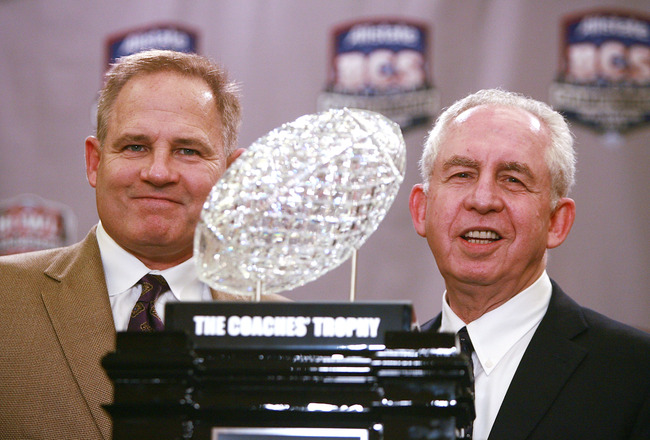
This trophy may be a relic if present alignment trends continue. 4

Don’t forget to vote in the fan polls!

To advertise with The Daily Hat Trick, or to submit a guest column, please contact the editor at eric@thedailyhattrick.info.


1) Image from fotosearch.com
2) Image from zimbio.com
3) Image from big12journal.com
4) Image from bleacherreport.com

Friday, December 17, 2010

Even the BCS Can't Smoke a Cuban

Do you like sports (probably so if you are reading this Pulitzer worthy material)? Do you enjoy following a sport all the way through the end of a season? Do you like to know who the champion of a sport is? Do you like college football? Were I on the radio, this would be the point at which you would hear the giant needle scratch and the music coming to a sudden halt. There is no champion of college football.

Sure, there are bowl games. There are multiple media polls, ranking the top 25 teams in FBS college football at the conclusion of each season. There has been a Bowl Alliance, a Bowl Coalition, and, of course, the ever-so-popular Bowl Championship Series, or BCS. However, there is no NCAA Championship in Football Bowl Subdivision (i.e. major schools) college football. It is a MYTH!

The end result is that politics, relationships, and business heavyweights in media and sports sponsorships ultimately decide who can and cannot have a seat at the dinner table in Club BCS. In 1984, Brigham Young University, quarterbacked by Heisman Trophy finalist Robbie Bosco and coached by the legendary Lavell Edwards, won the mythical consensus National Championship (Associated Press Poll and United Press International Poll). Proponents of the BCS view the arrangement as progress. Yet the 1984 BYU Cougars, under a BCS-like arrangement, may have never had an opportunity to be considered for the BCS Championship because of its membership, at that time, in the non-automatic-qualifying Western Athletic Conference.

Since 1984, schools such as Tulane, Utah, Texas Christian University, Boise State, and Auburn (member of a BCS conference) have posted perfect records (more than once, in some cases) yet never had an opportunity to play in any the mythical championship games. College football fans should consider this to be unacceptable! We watch, we attend games, we follow our schools, many of us follow other schools with compelling stories, and we get shafted with this corporately orchestrated production at the conclusion of each season. We deserve more.

Enter Mark Cuban

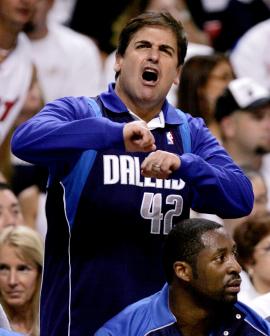
I have been an outspoken critic of billionaire Mark Cuban, owner of the Dallas Mavericks of the National Basketball Association. I perceive him as egotistical, inwardly focused, obnoxious, and megalomaniacal new money, having earned a fortune, and cashing out in time, during the dot com 1990s. I think he gets too involved in the day-to-day basketball operations of his team. I think words come out of his mouth far too often during games while he is seated courtside, instead of in an owner's box. I think that Mark Cuban is EXACTLY what college football fans need.

They should have never given this dude money. 3
For all of my criticism of Cuban, 52, there is little doubt that he is a smart businessman who knows how to take care of the people that work for him and give the fans a superior quality sports entertainment product. He is a visionary. In other words, he knows how to give people what they want for the purpose of achieving his desired ends.

Yesterday, Cuban stated, during a sports radio interview on the Dan Patrick Show, that he would invest his personal fortune into creating a playoff system in NCAA FBS football and eliminating the current BCS system. There is a fine line between madness and brilliance. Getting on nationally syndicated radio and stating that you single handedly plan to dismantle an institution that has controlled college football's postseason with hundreds of billions of payout dollars to conferences for over a decade, in spite of being very unpopular with fans, may sound like madness. When you are a relatively young billionaire with a proven track record of success, often through unconventional means, it may be brilliant.

Show Me The MONEY!!!!

I do not pretend to know the finer details and politics of sporting event financing. I have written, helped produce, and sold media. At the end of the day, the message is always...ALWAYS, "Get the money!" GET THE MONEY. Guess what? Mark Cuban has the money to make more money. The BCS pays out approximately $110 million to athletic conferences and universities for participating in a BCS bowl.

Cuban has guys like this shaking in their boots. 4
Having a net worth of $2.3 billion 2, Cuban has the resources to fund the BCS payouts himself, possibly with his Christmas money. I am also quite confident that Cuban is well acquainted with other super-wealthy individuals. I have little doubt that Cuban, between his own wealth and his contacts, is capable of arranging the financing necessary to lure the six major conferences (SEC, ACC, Big East, Big XII, Pac-12, and Big 10, which also has 12 teams - that's logical) away from the fascist BCS. The mid major conferences need little inducement to follow and its member universities may all award an honorary doctorate to Cuban should he succeed in his mission.   

Cash is King; Television Is It's Prince

Tickets sales and other stadium revenue are an important source of income for universities. However, the power brokers, the conferences, the NCAA, as well as university athletic departments, earn their bread an butter through the media, particularly television. I have read countless estimates of the amount of annual television revenue projected to be generated should college football implement a playoff system, upwards of $1 billion. Cuban and any investors he should choose to embark on his playoff mission need to reduce the risk and increase the profit potential for conferences and television networks.

If you buy into my premise that people want a playoff system in college football and do not like the current BCS system, then it follows that more people will support a playoff system (TV viewing, tickets sales, travel, etc.). If there is greater demand for a playoff system, then advertisers and sponsors will pay more to have placement in the playoff events. If sponsors will pay more for placement, then television networks will pay more for broadcasting rights for a playoff system. If there is more revenue available from broadcasting rights, then Cuban, et. al. can afford to invest more in payout money than the BCS currently offers to its member conferences. The details may be complicated, but the numbers are fairly simple. Cuban can make this happen, financially.

Common sense Always Wins in the Long Run

A true playoff system in college football: the fans want it; the coaches want it; the players want it. So why has it not happened? The decades-long legacy of the fragmented political structure of major college football is a perverse system in which the whole is equal to less than the sum of the parts. What does that mean, exactly? Each of the individual power brokers - the BCS itself, the bowl committees, the athletic conferences, and individual universities - have a good, profitable arrangement in place. To date, not enough of those power brokers have received enough inducements to offset the risk of scrapping the current system. Make no mistake; the BCS, as it is, is a gravy train for the BCS conferences and all of the other stakeholders in the BCS. And the axiom, "If it ain't broke, don't fix it." is the gospel truth to these entities. It will take cold, hard cash, a bunch of it, to encourage the necessary stakeholders to act.

Cuban has the vision. Cuban can arrange the cash. Cuban has the people that make college football's profitability possible, the fans, on his side. The BCS is on borrowed time. Cuban may emerge as the ultimate "BCS Buster". Good luck, BCS. Because in America, it is very difficult to smoke a Cuban.

Don't forget to vote in today's fan poll!

Getcha popcorn ready! 5

1) Source: collegefootballpoll.com
2) Source Forbes.com: April, 2010
3) Image from cncpal.com
4) Image from orangejuiceblog.com
5) Image from thenextweb.com